Ask Me About Bike Bus
Some personal reflections on the Global Bike Bus Summit 2026, Lisboa
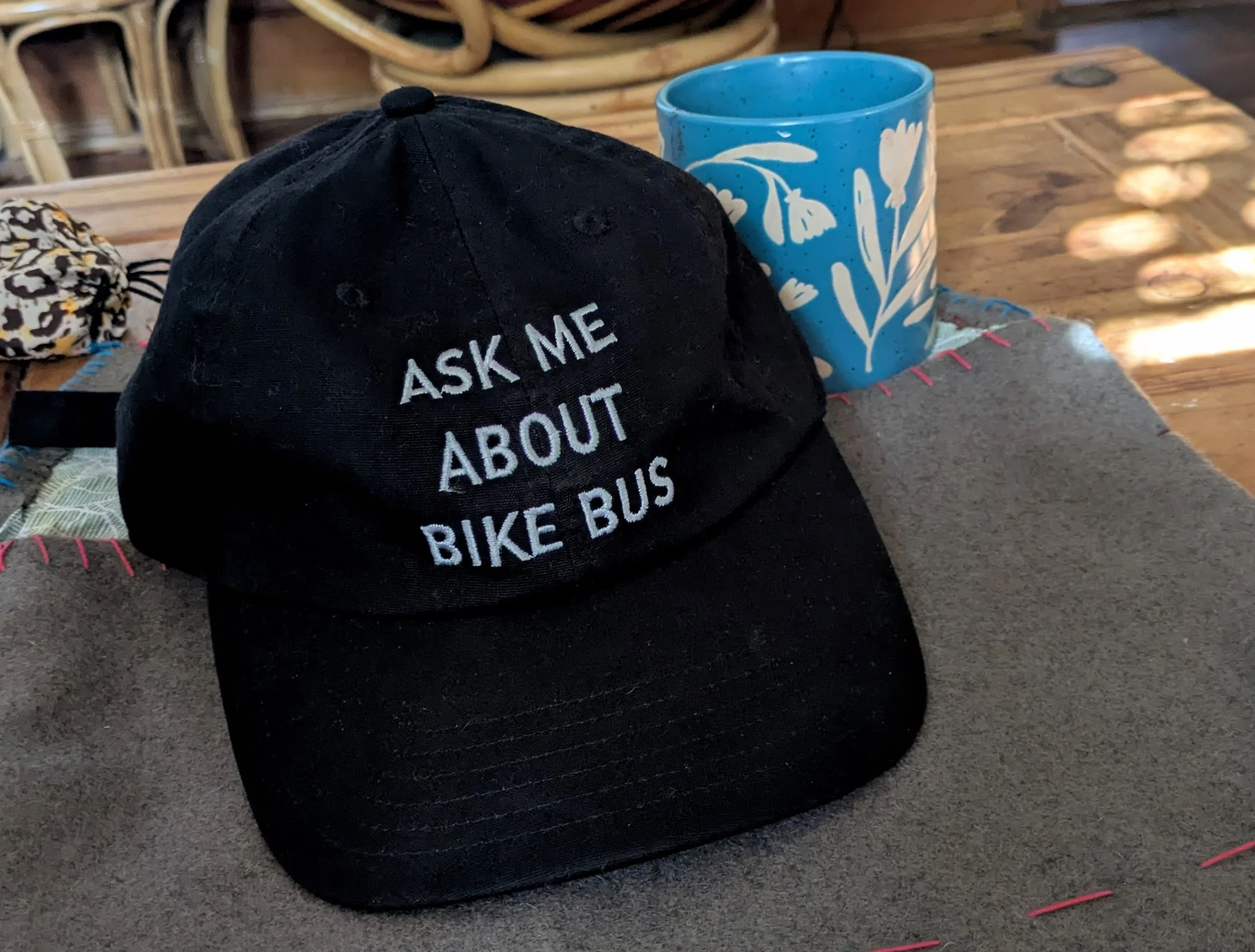
Bike World baseball cap courtesy of Coach Balto.
I'm writing this on the way home. I'm still wearing the hat.
It's a simple black cap that Portland’s Coach Balto from Bike Bus World gifted to delegates at this year’s Global Bike Bus Summit — it says: Ask me about bike bus. I haven't taken it off. It feels like the right way to carry something that's big, complex and too emotional to put into words.
Just a note before I get started - there were so many threads that I could have pulled on following this last week but these are just a few that are standing out the most for me.
Getting Around
Lisbon is loud. Beautiful, chaotic, wonderful, unapologetic and really loud. I found that this created tension in my body that needed regulating in the city’s many wonderful green spaces.
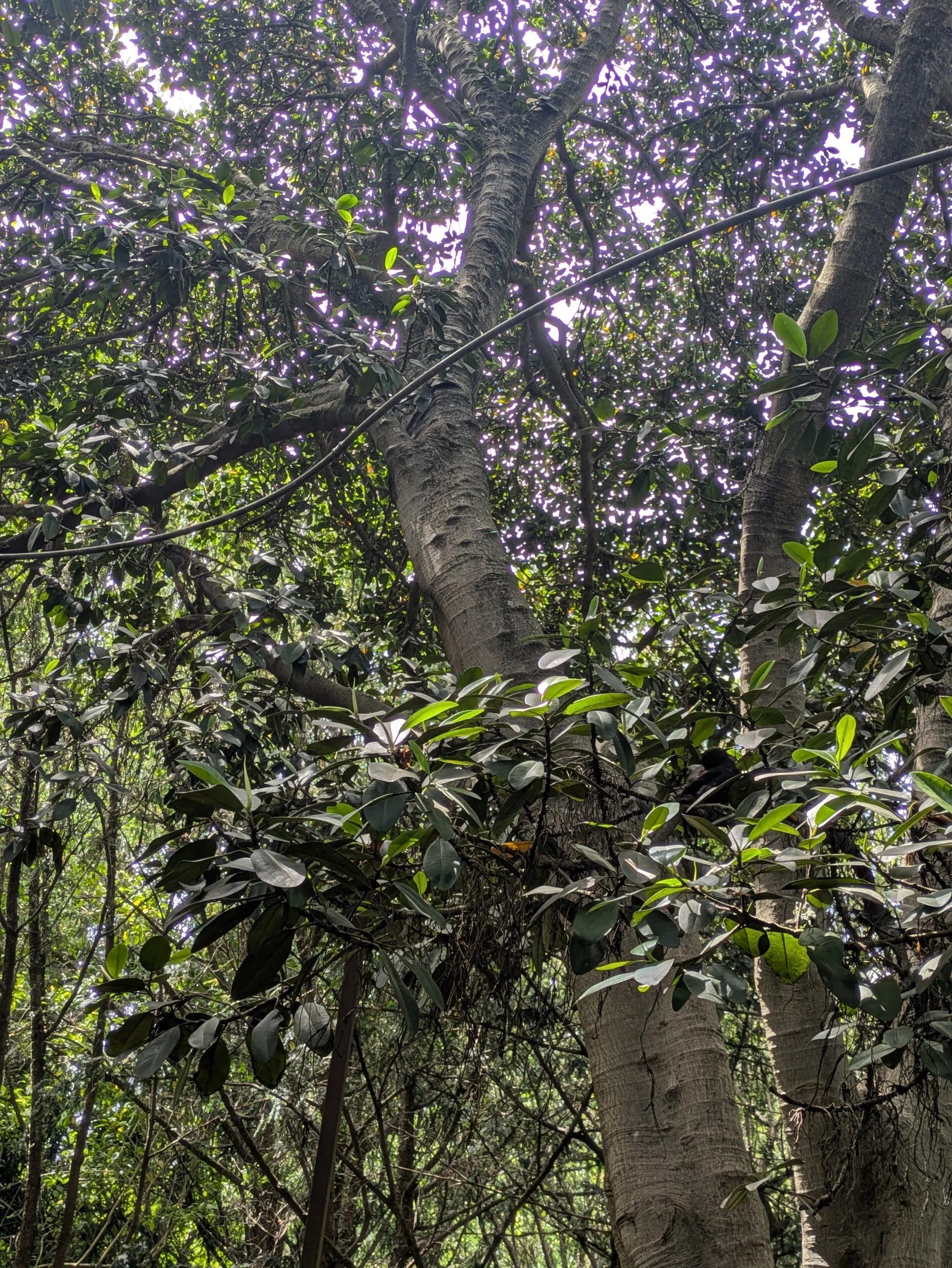
Awesome rubber trees in Lisbon’s beautiful Gulbenkian Garden.
Getting around on the city’s rental bikes — electric, heavy, a little unpredictable — was an experience all of its own. The infrastructure was intimidating; narrow streets, cobblestones, tram lines, fast traffic, the kind of roads where you have to hold your breath, and often your nerve. And that felt quietly important. Because this is exactly why what Bike Worcester does matters: demanding better infrastructure so that cycling as a cheap, clean, sustainable active travel choice is given the kudos it deserves.
There was real joy in it too — navigating the city in groups, finding each other at junctions, shared vigilance as we navigated ourselves and two children through an unfamiliar, busy city, and also the shared experience of arriving somewhere as a team, together. That is, in its own way, what a bike bus is. Bike Buses are the global clarion call: we're not waiting for perfect conditions. We're building something in the middle of imperfect ones. In the simple but powerful words of OC, a nine year old Worcester delegate and Global Bike Bus panellist , when asked about the polarisation and toxicity of debate on the issues (and I’m seriously understating the brevity of this as an experience):
Is it illegal? (No) Then just do it.
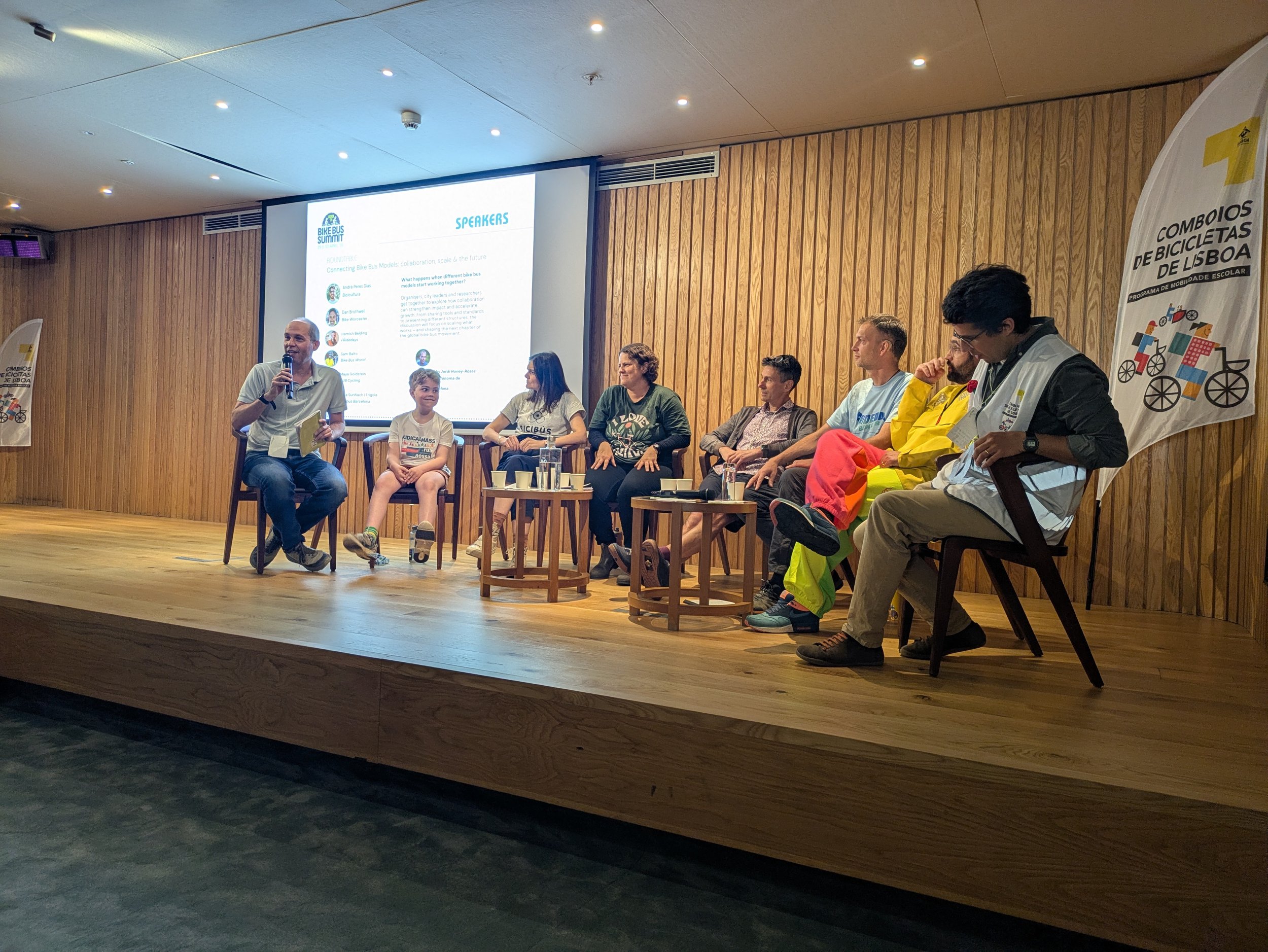
Connecting Bike Bus Models - OC joins Global leaders roundtable discussion..
A Room Full of People Who Get It
The summit brought together bike bus communities from England, Scotland, Barcelona, Austria, Vancouver, Portland, France, and of course Portugal and beyond (I’ve likely missed more than a few too). Hearing different models — different approaches, different contexts — was genuinely fascinating. The Portuguese perspective, and their relationship with existing transport networks opened up questions I hadn't thought to ask.
Some central themes that have stayed with me since the two-day summit are - we all have different working models, different relationships with local stakeholders, different risks and resilience factors and different tensions and focus points. We also share the same passion for Bike Buses but also a passion that looks beyond children’s bike buses and recognises that what we're doing is part of something much larger. We are not just getting children to school. We are reimagining what streets are for.
What We Brought to the Room
And while we’re talking about imagineering, our workshop was facilitated by myself, Katie, and Al from CoLab Worcs on behalf of Bike Worcester. I'm not sure participants knew quite what to make of us when we started by asking them to represent their Bike Bus route as a simple line with a few details of the ride itself - a geographical feature, landmark, local residents or workers who we have come to share a joyful and a regular human connection with.
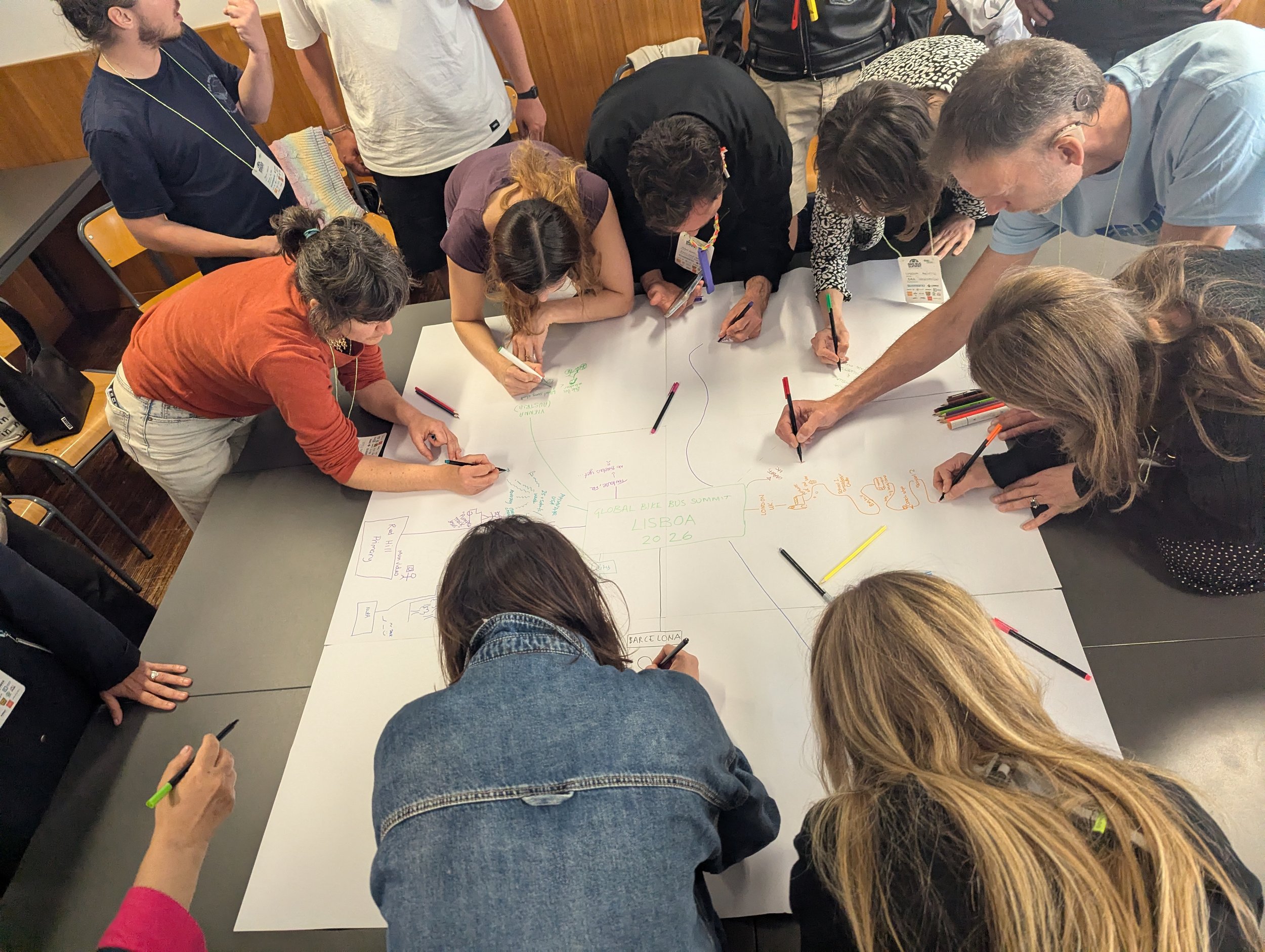
Delegates in our Community Engagement session representing their Bike Bus routes to create a global map of bike buses.
With the framing set we asked people to do something a little different. Not to think about logistics or numbers or routes — but to imagine their individual bike bus. This started with building a collective soundscape of a Bike Bus morning. These sounds created a foundation for us to soften our gaze and widen our experience of our bike buses. Who waves? Who notices? What conversations happen at the meet up point and the school gate that have nothing to do with cycling? What does it feel like to be known on your route, to be watched out for, acknowledged? What are the deeper relationships that have formed? We were trying to get at something that doesn't always make it into the data: the community building that happens in the spaces around the bike bus. The cohesion. The belonging. The small, unremarkable moments that add up to something significant.
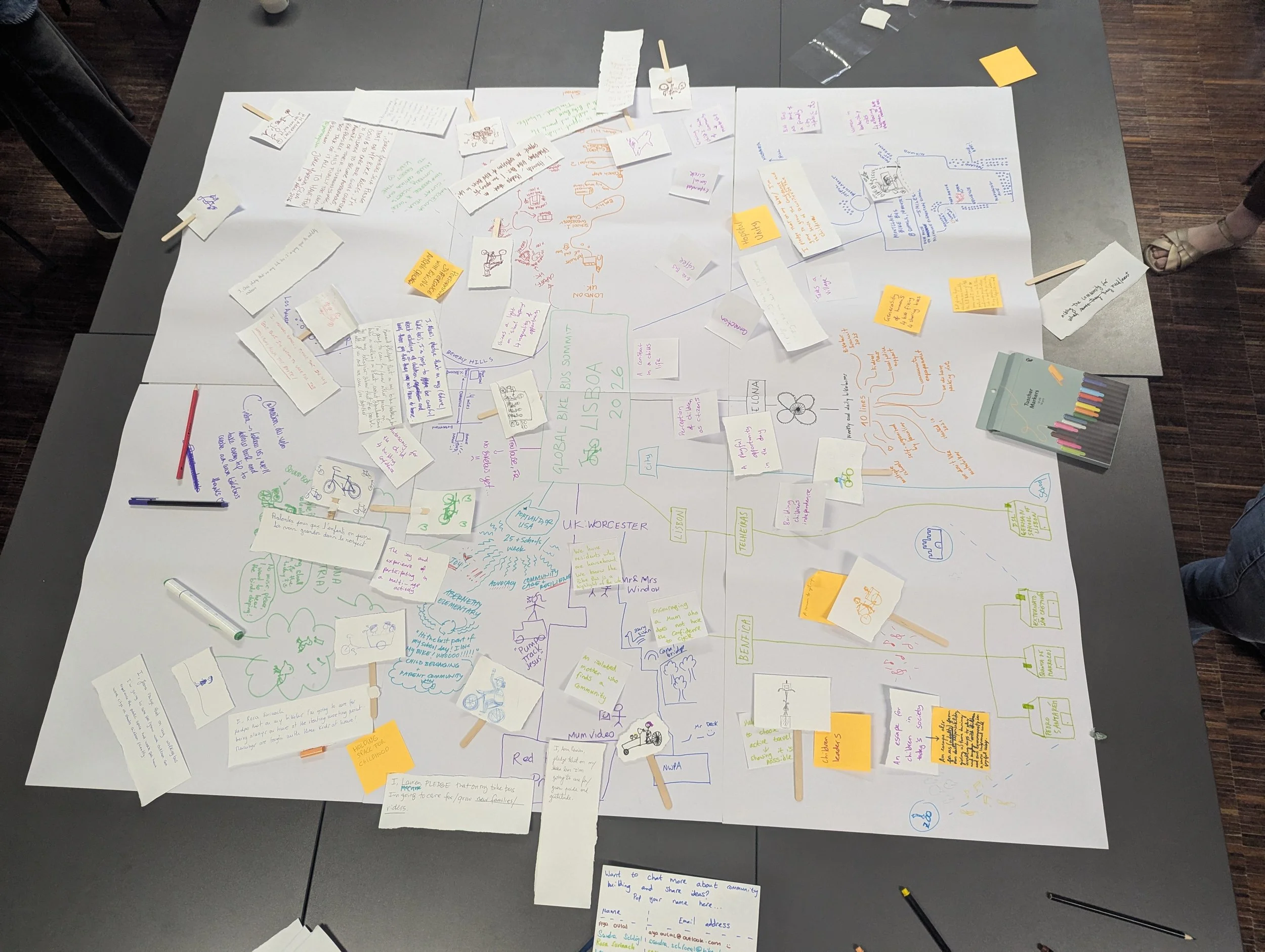
The completed Global Bike Bus Map -with bicycles on a stick and participant’s pledges.
To finish we asked each person to make one pledge — one thing they would commit to grow the community cohesion on their bike bus. We’re looking forward to continuing this conversation with the participants who want to share more about their communities. It’s exciting to hear how others are looking at how the movement is part of a broader conversation about place making and community building.
The Politics (Because There Always Is Some)
A summit like this wouldn't be honest without acknowledging some of the harder conversations.
I also attended a presentation - Women Caring, led by three awesome women Katherine Cory of Women on Wheels , Mireia Piqueras of Barcelona’s BiciBus and Ines Sarti Pascoal an academic at Lisbon’s Nova FSCH - who provided a gendered perspective on the shape of bike bus programmes and through personal stories explored how everyday cycling could be safer, more inclusive and representative.
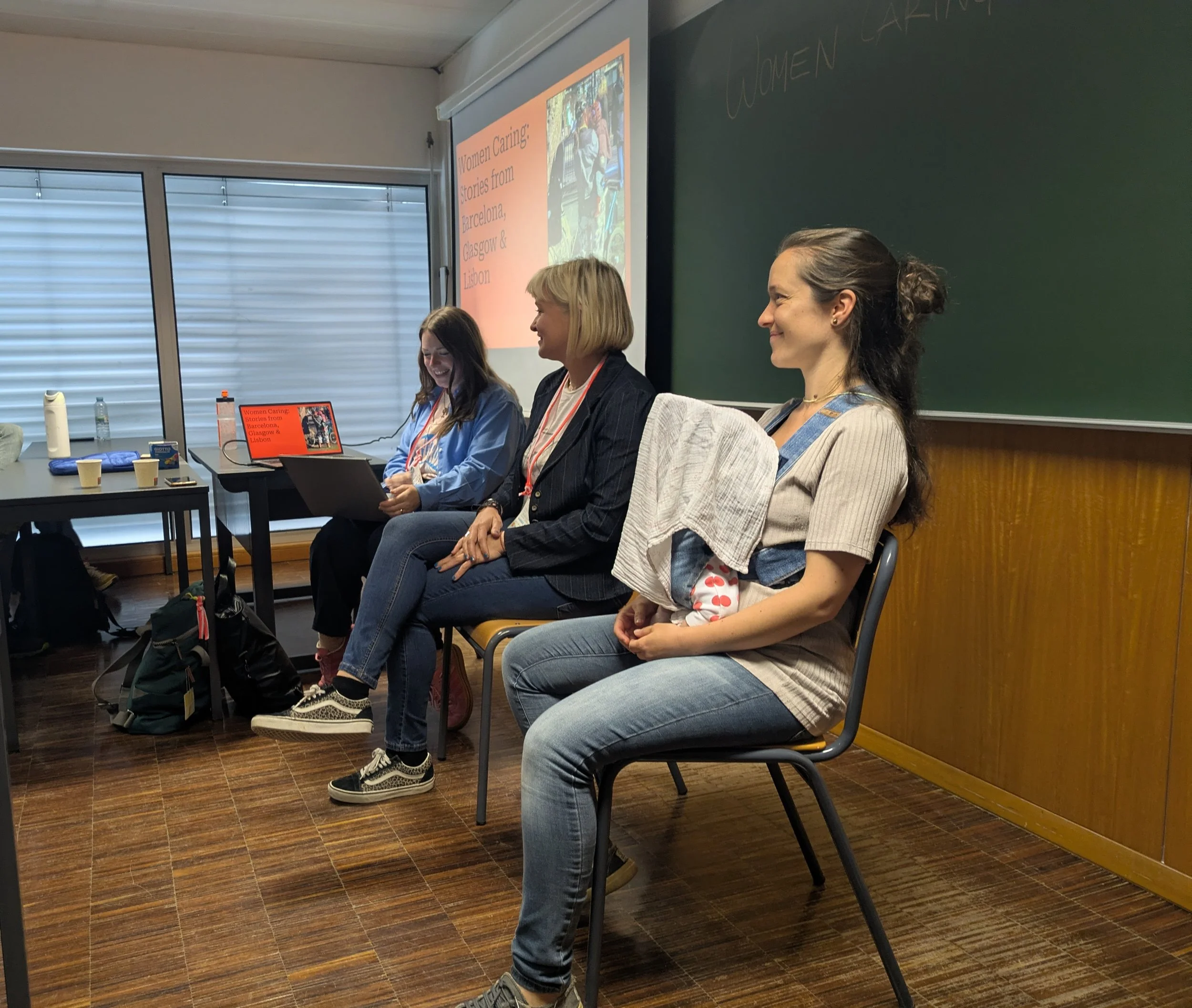
Katherine Cory, Mireia Piqueras & Ines Sarti Pascoal (& baby) present the Women and Caring session.
A reminder that as we see rollback of women’s rights across the globe we need to continue to platform our gendered experiences and build networks of support.
I later had a conversation with the Bike Bus chair about something that doesn't get named enough: the mental load of being a woman moving through public space. The extra thought that goes into planning a route. The calculation of whether a street feels safe at a certain time. The things we do, almost automatically, to make ourselves feel safer. It isn't specific to cycling. But cycling brings it into sharp relief. And I think it's a conversation the active travel world needs to keep having.
Related to this, one of the quieter but significant things that came out of this summit during the breaks and networking spaces: was the setting up of a platform for women involved in bike buses globally. A point of contact. A thread connecting us across cities and countries and shared experiences. It's early days — we're not quite sure yet what shape it will take — but it felt important to create the space and I’m excited to see what shape it forms.
Another conversation I had with someone over dinner was about closer to home, Worcester has its own infrastructure problems that are much reported within Bike Worcester. There's a Traffic Regulation Order on the high street that prevents cyclists from passing through between 10am and 6pm — which cuts off routes, makes our journeys longer and harder, defeats the point of being on a bike and forces those of us who persist, to use the busy, often congested roads.
There is almost no dedicated cycling infrastructure in the city and some motorists pass cyclists too closely and these interconnected issues are something we talk about a lot in Bike Worcester, (we've even just made a film about it - watch this space). It's one of the reasons more people don't cycle, particularly on our roads.
But the conversation went further as there is also a lobby to separate cyclists from pedestrians which can be contentious. There is a perception among some pedestrians - particularly those who might already feel vulnerable because of mobility and health issues, responsible for small children, pushchairs, wheelchairs and dogs, that they've been close-passed by a bike. This is definitely conflated as an issue and is likely more of a perception than a reality but I think we need to hold that too. It should be a shared conversation about who our streets should be for (clue: citizens not cars), who they work for and who they don’t work for.
These are not small things. They are the water we swim in (or the paths we cycle on).
What I'm Carrying Home
I've come home with more questions than answers.
How do we bring children's voices authentically into these spaces? How do we include the voices of those who care for and about them? What movement will the women of the global bike bus begin to grow? How will this experience enhance the awesome movement we have in Worcester? These are just a few of the questions I’m sitting with….
Something is happening here. I'm not sure any of us can fully see the shape of it yet. But I know I want to keep showing up for it.
If you see me around Worcester, do ask me about bike bus.