I don’t wear a helmet when cycling in Worcester; this is why
So before I start, I’d like to be clear that not wearing a helmet while riding a bike is my own personal choice, and I’m not trying to persuade other people to not use a helmet, or otherwise. I use a bike as a mode of transport most days, and have commuted to work by bike for over 20 years, so I’ve got plenty of miles in the legs, and experience in the noggin, I generally ride at a leisurely pace, and have a good understanding of the Highway Code, what to expect of drivers (good and bad) and how to look after myself on the road. I don’t expect to crash.
There are occasions when I do still reach for my helmet, notably when I think I’m more at risk of falling off, so mountain biking, or challenging descents when bike packing or touring, or maybe if I was cycling with snow or ice on the ground. On the whole I think it’s sensible that children wear a helmet for a variety of reasons; they tend to crash more, it can help with confidence when learning, and riding in a bike seat introduces different risks, but even that’s not an essential.
Anyway, lets get started.
Helmets are a barrier to mass cycling
So this is my own pet theory, but in a society where there’s an expectation that you should wear a helmet when cycling, it’s another piece of equipment you need to buy (a quick look online and prices range from £10 - £250), maintain, replace when it’s old, store, and perhaps most importantly, find when you want to use your bike. So my hypothesis goes that at some level this puts people off making some journeys by bike, and therefore becomes a barrier. If you’re a family with children that becomes a problem multiplied.
It also becomes seen as an activity that is dangerous, so dangerous in fact the you need specialist safety equipment before you start. It benefits the whole of society if more people make more journeys by bike, not least the people that still want to travel by car (fewer cars innit).
Finally, visit anywhere in in the UK or the world where cycling as a mode of transport is normalised, and you’ll see the majority of people cycling without a helmet, to the extent that on arrival a few years ago in the Netherlands I ditched my lid at some point after leaving the ferry port and arriving in Amsterdam; it just felt…weird.
Managing Risk
If we take the time to consider the risk when cycling in an urban environment, and I’ll chip in with my own experiences here, the biggest risks are other road users, notably a small minority of drivers who do so antisocially, dangerously, and lets face it, illegally.
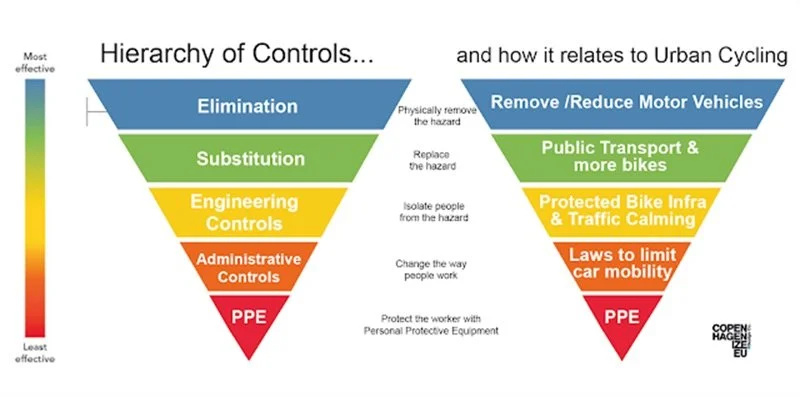
The Hierarchy of hazard control is a widely accepted system promoted by numerous safety organisations, and used in industry to be promoted as standard practice, as well as informing public policy.
The hazard controls in the hierarchy are, in order of decreasing priority:
The diagram below provides some examples of how the system applies to cycling, and Personal Protective Equipment (PPE) aka wearing a helmet is considered the least effective safety measure.
Now I haven’t just chosen to not wear a helmet, I also spend a fair amount of time with other Bike Worcester volunteers advocating for everything above the red triangle, but you’ll have to read our other blogs for more info on that.
Risk compensation; does wearing a helmet induce more risk taking?
Risk compensation is a theory which suggests that people typically adjust their behaviour in response to perceived levels of risk, becoming more careful where they sense greater risk and less careful if they feel more protected. So does wearing a helmet encourage you to take more risks? The page on Wikipedia is a good read, and even provides references where studies have been undertaken on people wearing bike helmets.
My layperson’s example would be going climbing. I’m pretty comfortable with heights, and also pretty trusting of safety systems, so given a climbing wall within my skill set I’m happy to put on a harness and haver someone belay me while I climb to the top. I’d expect to do this without relying on the rope, so would I do it without a rope? Unlikely. The safety device has changed my view of the risk; so reasonable to think the bike helmet would provide comfort for me to take more risks when cycling.
Benefit in collisions…right?
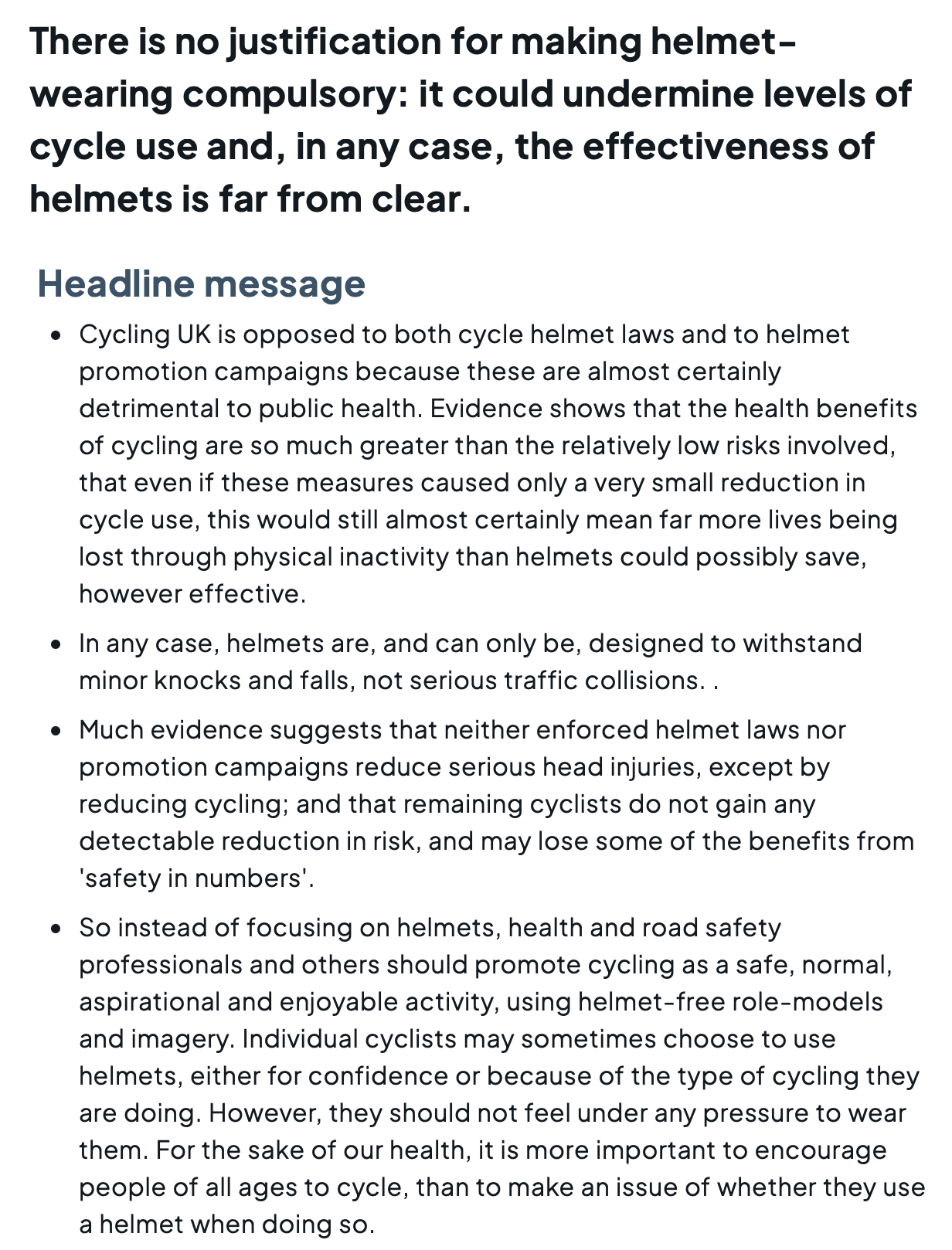
Dipping a toe into academic research on this issue, specifically that wearing a helmet reduces the risk of injury, and the answer appears to be…complicated. It would appear foolish to suggest helmets provide no protection. Meta-analyses show that helmets are associated with lower odds of head, brain and facial injuries, however the benefit is not universal, and this becomes more complicated when considering neck injuries. Oh, and there’s an increased risk if children are wearing bike helmets in different situations, for instance on play equipment, particularly if they’re incorrectly fitted. Wikipedia has a introductory summary here (including the beautifully understated comment ‘they are less useful when a motor vehicle is involved’), and its also worth reading Cycling UK’s information on helmets, particularly the headline message:
Testing standards: are fall heights and speeds realistic?
The standard for adult UK and EU helmets for cycling and skateboarding is BS EN 1078:2012 (there’s a separate one for children’s helmets) which covers testing. I wouldn’t mind reading it, I suspect it’s fairly dry, but it costs £232.
Given that, I’m going to use t’internet and see what other folk have said. Here’s a key point: the standards to which many cycle helmets are certified assume modest drop heights and speeds; a headform drop from about 1.5 m for a flat anvil and about 1.0 m for a kerbstone anvil. In my quick internet search I can’t find anything with a diagram to further explain that. So I’ll quote this from whycycle.co.uk ‘Cycle helmets are only designed and tested to withstand an impact equivalent to an average weight rider travelling at a speed of 12 mph falling onto a stationary kerb‐shaped object from a height of 1 metre.’
I know I’m not a medical professional or road collision expert, but going back to my view that the biggest risk of me falling off a bike when cycling is a collision with someone driving a car, this doesn’t sound like a bike helmet has been tested for that scenario (or even me cycling down a hill), and to my mind is giving all road users a false impression that wearing a helmet does protect you from such an incident. I guess if bike helmet manufacturers made this clear on the packaging they’d sell less bike helmets.
The Wikipedia page also references a book called Cyclecraft by John Franklin, and suggests the author is skeptical of the merits of helmets, regarding proactive measures including bike maintenance and riding skills as being more important. I’ve just bought a copy.
Why stop at helmets; what about other protective equipment?
It’s interesting how obsessed we are about helmets, but close to silent on other cycling equipment.
My go to equipment is a pair of gloves, fingerless in the summer; on the rare occasion I ride without them it feels super weird. They help with gripping the handlebars, offer a bit of protection for the palms of your hand if you hit the deck, and obviously keep your hands warm in the cold and / or wet.
For children they offer the added protection of falling over when they’re not riding bikes, for instance if you’ve stopped to have a play somewhere.
On occasion I’ll also wear glasses, particularly on longer rides and depending on the time of year. It’s pretty common to catch a fly in your eyeball, and occasionally you get debris in the face from passing cars, with that’s bits of grit or dust (think about dried dirt around farm entrances) plus occasionally drops of manky water as you cycle through puddles.
Other safety equipment available are knee and elbow pads, mouth guards, and back and neck supports, and also full face helmets, all of which are worn in competitive downhill mountain biking and BMX competitions.
Given I’m often questioned about wearing a helmet in case I’m involved in a crash with someone driving a car, where is everyone’s concern for the other bits of my body?
Driver behaviour and the Ian Walker study
One of the more provocative findings on this topic is that drivers may treat helmeted cyclists differently. In a study by Ian Walker he cycled around Salisbury and Bristol half the time wearing a helmet, half the time not, and measured overtaking distances using an ultrasonic sensor. He found that motorists passed closer when he wore a helmet; on average about 8.5 cm closer.
Walker suggests drivers perceive a helmeted rider as more committed, faster, more predictable, and so give them less space. If this effect is real then helmet‐wearing could paradoxically reduce safety margins by changing how others respond to you.
Which brings me onto the use of a Pass Pixi.
Why not use a Pass Pixi
Inspired by Ian Walker, and having used a Pass Pixi and sort of got the sense that close passes on my commute were less frequent, I done a spreadsheet and started counting.
What’s a Pass Pixi? Apologies, its a sign or badge that resembles the traffic sign indicating a speed camera that you can attach to your clothes or panniers, basically indicating to drivers that you might have a camera videoing your ride.

The results are in another blog here, and this is at best half arsed science(ish), but using a Pass Pixi approximately halves the frequency of close passes by drivers. So possibly the opposite effect of wearing a helmet in Ian Walker’s study. On average. On my commute.
Anyway, we have some to give away FOC, courtesy of a West Mercia PCC grant a few years ago. And another pet theory, if drivers get used to seeing people riding bikes with a Pass Pixi, maybe that reinforces and embeds the requirement for drivers to leave 1.50m when passing. Now we just need West Mercia Police to take reports of close passes via Operation Snap as seriously as other forces (but that’s another blog).
Other stuff I do where I might bash my head
Well, there are lots, and I can speak from personal experience (which is irrelevant as it’s anecdotal) but it’s odd that there’s an expectation one should wear a helmet when riding a bike, but not so much doing other stuff.
I’ve had a root around on the interwebs to try and find some nicely packaged and presented statistics for the UK but I’m struggling; please post below if you can find something and I’ll revise the blog.
I’ll try and summarise. According to NICE approximately 1.4 million people attend emergency departments in England and Wales each year with a recent head injury; 33–50% of these are children aged under 15 years. Typical causes are falling over (from beds, ladders, down stairs, in the bath or shower, or trip hazards), Road Traffic Collisions (affecting pedestrians, people in cars, cyclists and motor cyclists), sports and recreational activities, physical violence and assault (including domestic and child abuse), and falling objects (eg. in construction).
Children and people over 65 (apologies, I didn’t draw the line there) have a higher frequency (I guess on average they fall over more), as do men under the age of 40. As an example, alcohol is a contributing factor.
So as well as choosing not to wear a helmet while cycling, I also don’t wear one when driving, as a passenger, when walking next to a road, taking a shower, going up or down stairs, playing football or rugby, or going to the pub. Or returning from the pub. Or sensing a bit of aggro in a pub. I do wear a hard hat when working on construction sites (where interestingly there’s much greater assessment and control of risk and collection of injury and near miss statistics than other high risk activities, such as driving a car). I have hit my head as a result of doing some of these things. It’s a risk I’m prepared to take, and apparently the vast majority of people agree.
Friendly advice from others
So we’ve established I cycle a fair bit, usually as a mode of transport, and I don’t tend to wear a helmet, and I’ve lost count of the number of times people have pointed this out, both in person and commenting on the socials or blogs like this. I’ll usually say I don’t wear one when driving either, and hope that’s enough to move on, and then think ‘I should really write that blog about why I don’t wear a helmet’.
What’s fascinating is that people feel comfortable to share their wisdom on this topic, but I can’t think of another example that even comes close to the frequency. We’ve clearly been collectively conditioned to frown upon people who are prepared to take the risk of cycling without a helmet, but at the same time as a society take risks with much greater impact; consider speeding, smoking, and inactivity. Bonkers.
Minor reasons, but not irrelevant
Maybe I’ll whisper this bit. I don’t really like wearing a helmet. They’re a bit uncomfortable (particularly on a long ride), and, you know, I’m just not really a fan. In the summer I’d rather feel the wind in my hair and enjoy the ventilation (if it’s a rare occasion that I’ve raised a sweat), and when the temperature has dropped I’d rather wear a wooly hat and keep my ears warm to boot.
When I cycled to school as a teenager I don’t remember them being a thing, and it was only when my own children started cycling we all donned a helmet out of solidarity. I started stopping when I got more interested in cycling advocacy about 10 years ago, and preference is defo sans casque.
The benefit of cycling and physical activity outweighs the head‐injury risk
Here’s the bigger picture: cycling offers tremendous net benefit, for the individual and for wider society. More cycling means fewer cars, cleaner air, healthier citizens, less congestion. The risk of head injury from cycling is small compared to the benefits of physical activity, regular movement, and reduced sedentary behaviour. If we over emphasise small risks (head injury) and make cycling feel unsafe and requiring specialist safety equipment (helmets), we provide a barrier to increasing rates of cycling, and the overall risk to the population then rises (in terms of inactivity, pollution and road danger).
So even if we accept that helmets reduce certain head injuries, if their promotion and / or requirement reduces the use of a bicycle for appropriate journeys, then we might be collectively making things worse.
So that’s it
We’re at the end. So wear a helmet, don’t wear a helmet, that’s up to you, but here’s a few things I would recommend:
Whether you’ve cycled your entire life or are just getting back in the saddle, it’s worth getting some training (now called Bikeability). You can reduce your risk by how you ride. Sign up here.
Get a Pass Pixi; I’m pretty sure they reduce the frequency of close passes.
Help us campaign to make our roads safer for everyone, demanding improved segregated infrastructure, raising awareness of the obligations of drivers, and requesting other road safety measures such as School Streets ands reducing speed limits.
Comments are open, be safe.